
Paver patios & walkways
Custom Paver Patios and Walkways in Monmouth County, NJ
The patio is the outdoor room your family will use most from spring through fall. True North designs and builds paver and natural stone patios and walkways for Monmouth County homes, starting below the surface with the excavation, base, and drainage that keep the finished surface level and sound through New Jersey winters.
A Patio Planned Around How You'll Use It
Before choosing a paver, we start with how the space will be used: a dining table for weeknight dinners, a lounge area around a fire, room for a grill or a full outdoor kitchen, or a landing that steps down from the back door. Those uses set the size, shape, and layout, and they decide where the patio should sit relative to the house, the sun, and the views.

The connections matter just as much. A patio that meets the door comfortably, flows into a walkway, and leaves room for plantings to soften its edges feels like part of the home instead of a slab dropped in the yard.
What we plan for
- Furniture and circulation, so chairs pull out and people move around easily.
- Connections to doors, steps, walkways, and the driveway.
- Sun, shade, privacy, and the views from inside the house.
- Room for what comes next: a kitchen, a fire feature, or lighting.
Built From the Ground Up
Most patio problems start underneath: pavers that sink, joints that open, puddles that never drain, and edges that creep outward. Those failures usually trace back to what was done, or skipped, before the first paver was set. That's why our patios start with the work you won't see once it's finished.
Excavation to stable ground
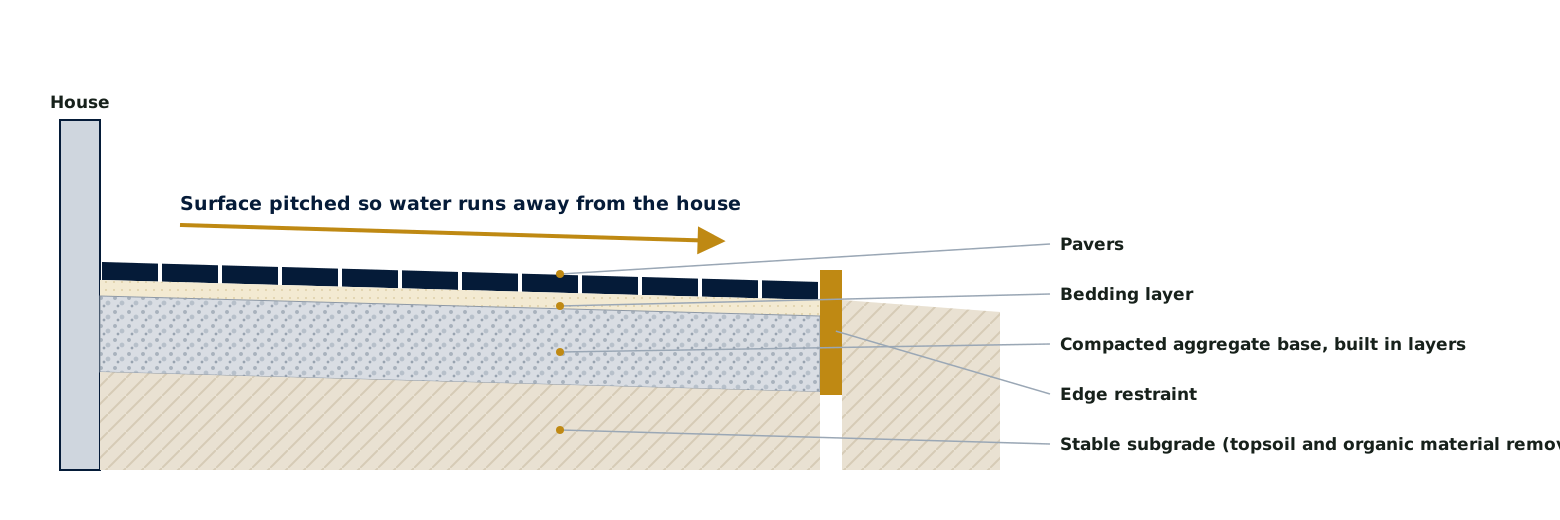
We remove topsoil and organic material down to stable ground, with the depth based on the soil conditions and how the patio will be used.
A compacted aggregate base
The base is compacted aggregate, built up in layers to create a firm, even platform that spreads weight and resists frost movement.
Slope that sends water away
Every patio needs a slight, consistent pitch so rain runs off the surface and away from the house, not toward the foundation or into a low corner of the yard. Where the surrounding grade works against that, we correct it as part of the project. Learn more about our drainage and grading solutions.
Edges and joints that hold
Edge restraint keeps the field of pavers from spreading, and properly filled joints lock the units together so the surface acts as one.
The result is a surface that stays level, drains the way it should, and still looks right years after the crew has gone home.
Concrete Pavers or Natural Stone
Both make excellent patios when they're installed correctly. The right choice depends on the architecture of the home, how the space will be used, and the look you want.
Concrete pavers
Concrete pavers come in a wide range of shapes, colors, sizes, and textures. Their consistent dimensions suit clean, tailored layouts and patterns, and they work especially well for larger patios, walkways, and spaces that tie into a paver driveway.
Natural stone
Natural stone brings color variation and texture that no two pieces share, and it suits traditional and coastal homes especially well. Each stone is set individually, so the installation rewards careful layout and an eye for detail.


Walkways, Steps, and Garden Paths
A walkway is the first thing guests experience and the route your family uses every day. We plan front entry walkways, side-yard connections, and paths from the driveway to the back patio so they're sized for real use, comfortable underfoot, and consistent with the rest of the hardscape.

Where the grade changes, a walkway may need steps, and they should be laid out so every rise feels natural and safe. Through garden areas, stepping-stone paths offer a softer route that lets plantings fill in around them.
For layout ideas, see our guide to paver walkway design.
Replacing a Patio That Has Settled or Heaved
If an older patio has sunk, cracked, or started holding water, the surface usually isn't the real problem. The lasting fix is to remove the old patio, correct the base and grading underneath, and rebuild it properly, which is also a chance to resize the space or add features the original never had.
The Foundation for a Complete Outdoor Living Space
A patio is often the starting point for everything else in the yard. Planning these elements together means footings, utilities, grades, and layouts are coordinated from the start instead of worked around later.

Outdoor kitchens
Built-in grills, counters, and storage set into the patio, with the space around them sized for cooking and serving. Explore custom outdoor kitchens.
Fire pits and outdoor fireplaces
A fire feature gives the patio a gathering point for cooler evenings and shapes where the seating goes. Explore outdoor fireplaces and fire features.
Retaining walls
On sloped lots, walls create the level ground a patio needs, and a low wall can double as built-in seating. Explore retaining wall construction.
Lighting and plantings
Path, step, and accent lighting carries the patio into the evening, while layered plantings soften its edges and tie it into the landscape. See how lighting and plantings fit into landscape design and installation.
Planning a complete outdoor living space?
Request a Design ConsultationBuilt for Monmouth County Ground
A patio has to be built for the site it sits on, and conditions change quickly across the county. Clay pockets hold water and can heave when they freeze, so drainage beneath and around the patio gets extra attention. Sandy soil near the bay drains fast but needs a well-compacted base to stay firm. Lots that fall toward the Navesink and Shrewsbury often need walls or steps to create usable level space. And every patio here has to handle repeated freeze-and-thaw cycles each winter.
We build patios and walkways throughout our Monmouth County service area.
How a Patio Project Comes Together
- Site visit. We walk the property, talk through how you want to use the space, and look at grade, drainage, access, and existing features.
- Layout and materials. We define the size, shape, connections, and materials. For larger outdoor living projects, this becomes part of a full design.
- Project estimate. Once the scope is defined, we prepare an estimate for the work.
- Excavation and base. The site is excavated and graded, and the base is built and compacted.
- Installation and walkthrough. Pavers or stone are laid, cut, and finished, and we walk the completed space with you.
Paver Patio and Walkway FAQs
How big should my patio be?
Start with the furniture and activities you're planning, then add room to move around them. A dining area needs space to pull chairs out and walk behind them, and a lounge area needs clear paths through it. Marking the outline on the ground before construction is an easy way to check the size in person.
Are pavers better than a poured concrete patio?
Pavers are individual units set on a compacted base with joints between them, so they can flex with freeze-and-thaw movement instead of forming the large cracks a poured slab can develop, and a single paver can be lifted and reset if needed. They also offer far more choice in color, shape, and pattern.
Do I need a permit for a patio?
It depends on the town. Many New Jersey municipalities limit how much of a lot can be covered by hard surfaces like patios and driveways, and some require a zoning permit for new hardscape. Those rules are worth checking early, since they can affect the size and layout of the patio.
When is the best time to build a patio?
Patios can be built through much of the year, as long as the ground isn't frozen or saturated. Spring and early summer schedules fill quickly, so planning over the winter gives you the best chance of using the patio that season.
Images on this page are AI-generated illustrations of design ideas. They are not photographs of completed True North projects.
Reviews
Proof From Local Homeowners
Reviews help homeowners understand what it’s like to trust True North with a full design-build project.
Ready to plan your patio?
Let's Build a Patio Worth Spending Time On
Tell us about your yard and how you want to use it. We'll help you scope the patio, the connections, and the work underneath it.