
Drainage & grading
Drainage and Grading Solutions in Monmouth County, NJ
Water always finds the low spot. When that low spot is your lawn, your patio, or the side of your house, the fix has to start with the ground itself. True North works out where water is coming from and where it needs to go, then regrades the property and builds drainage solutions that correct the problem at its source, not just where it shows up.
Signs Your Property Has a Grading or Drainage Problem
Most drainage problems are visible long before they cause real damage. If any of these sound familiar, the grade or the drainage on your property is working against you.

- Standing water that lingers for hours or days after a storm.
- Lawn areas that stay soggy, thin, or muddy no matter the season.
- Runoff that flows toward the house or pools along the foundation.
- Washouts, erosion, or exposed roots on slopes and bed edges.
- A patio or walkway that holds water, has settled, or ices over in winter.
- Water arriving from an uphill or neighboring property during heavy rain.
Diagnose First, Then Fix
The most common drainage mistake is treating the symptom: adding a drain where the puddle forms without asking why the water gets there. We start by reading the whole site.
- Where the water comes from: roofs and downspouts, uphill areas, neighboring lots, or ground that stays wet.
- How the grade moves it: the slopes, low spots, and reversed grades that send water the wrong way.
- What the soil does with it: whether the ground absorbs water or holds it at the surface.
- Where it can go: a safe, appropriate outlet that moves water away from the house without pushing the problem onto someone else.
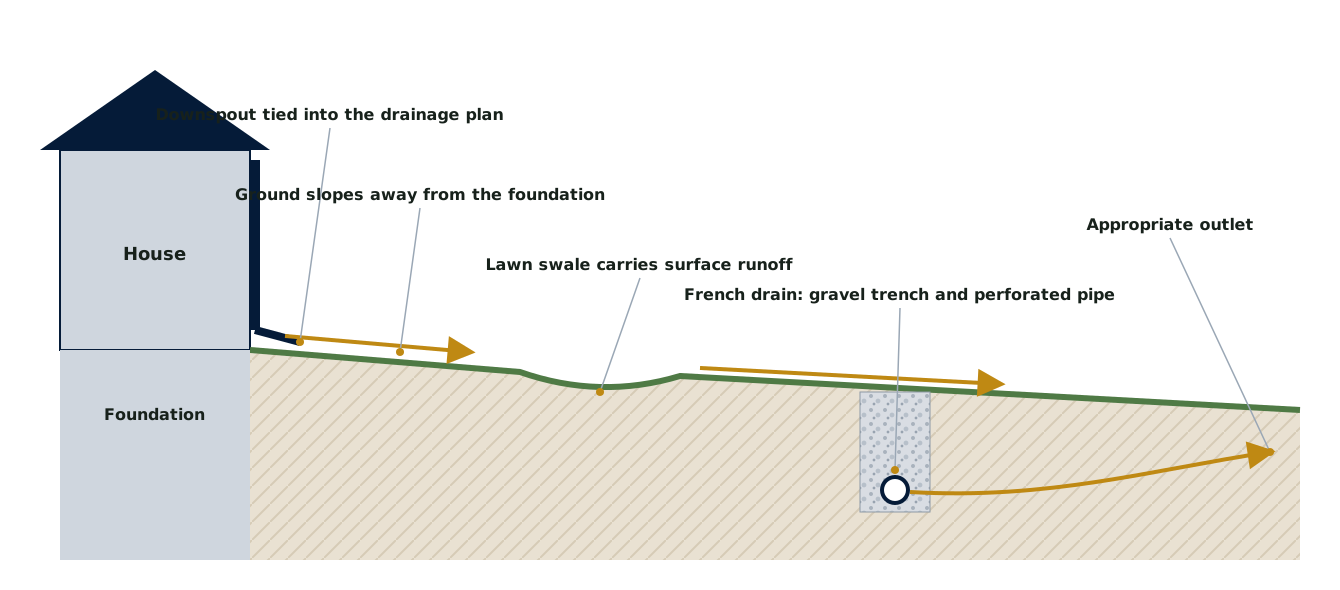
From there, the solution fits the cause. Sometimes regrading alone solves it. Often the best result combines grading with subsurface or planted drainage. For a closer look at why this comes first, read Why Drainage Comes Before Landscaping.
Grading Correction
Grading is the foundation of every drainage solution. When the ground is shaped correctly, most water takes care of itself.
Positive grade around the home
The ground next to a house should slope away from the foundation, but settling, old construction, and years of added mulch and soil often reverse it. Re-establishing that slope is one of the most effective ways to keep surface water away from the house.
Swales and surface flow
A swale is a shallow, gently sloped channel, usually lawn-covered, that collects runoff and carries it across the property to a suitable outlet. Done well, it's barely noticeable and handles large amounts of water during heavy storms.
Whole-yard regrading
When low spots, settled areas, and conflicting slopes add up, the right answer is often to regrade the yard as a whole. Reshaping the property gives water a clear path and leaves level, usable lawn and space for future projects. Disturbed areas are then restored with topsoil and new lawn or plantings.
Subsurface and Planted Drainage
Some water problems need more than surface grading. These solutions are often combined with regrading as part of one plan.
French drains
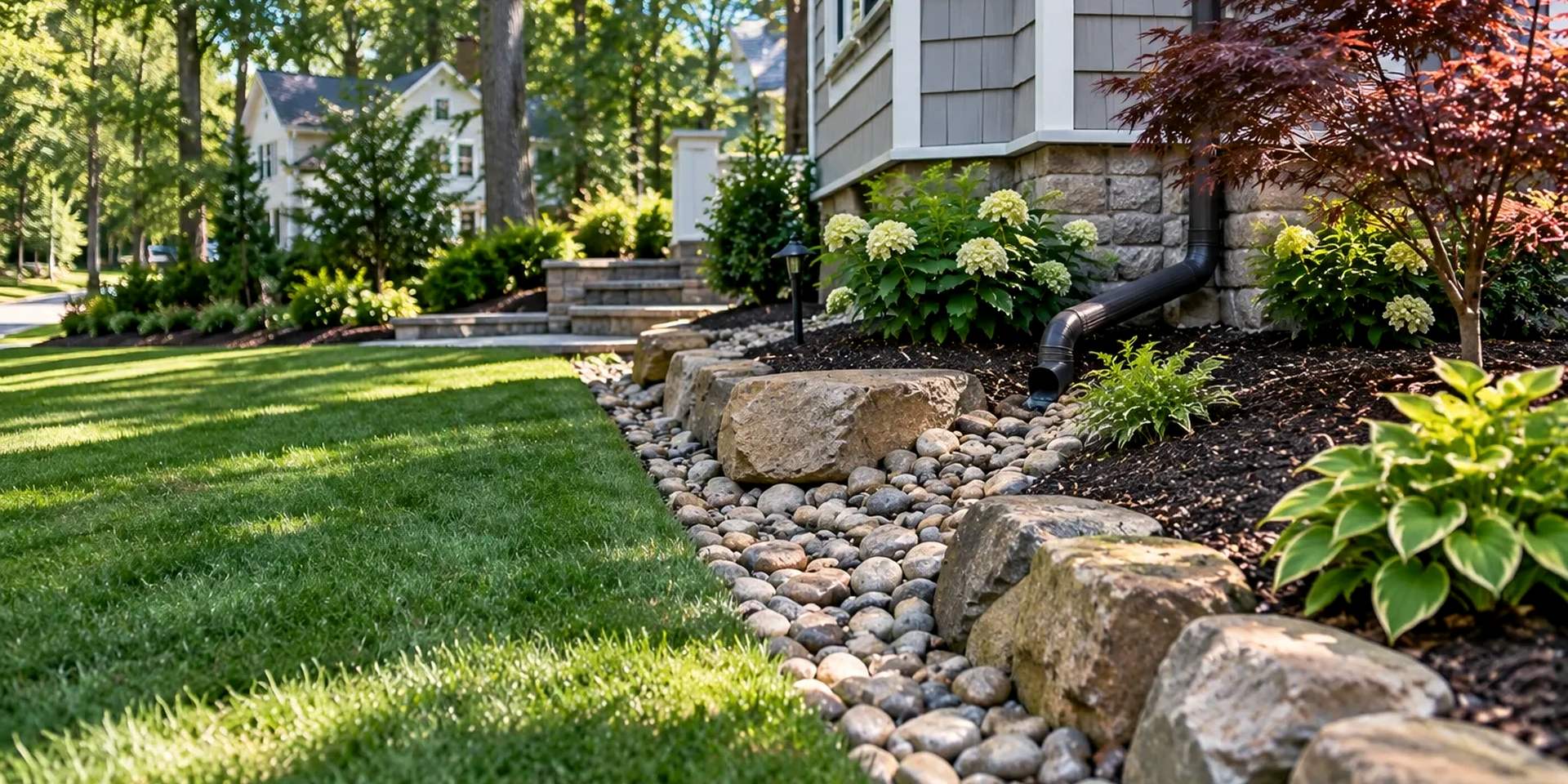
A French drain is a gravel-filled trench with a perforated pipe that collects water below the surface and carries it to an outlet. It's well suited to soggy lawn areas, wet ground along a foundation or behind a wall, and spots where regrading alone can't move enough water.
Roof and surface runoff connections
Roofs shed a surprising amount of water. Directing downspouts and surface drains into an underground drainage line, as part of a larger plan, keeps that water from soaking the ground next to the house or flooding the lawn below.
Rain gardens and drainage gardens
A rain garden is a planted, shallow low area designed to collect runoff and let it soak into the ground. It turns a chronically wet spot into an attractive part of the landscape while managing water naturally.

Drainage and Grading Before You Build
The best time to solve drainage is before a new patio, wall, kitchen, or lawn goes in. Planning grades at the start means new hardscape sheds water in the right direction, walls have somewhere to send it, and the finished landscape isn't built on top of an unsolved problem. That site work is part of every design-build project we take on, from rough grading through final grade.
Explore residential excavation and site work, or see how grading fits into landscape design and installation, paver patios and walkways, and retaining walls.
Drainage Challenges Across Monmouth County
Properties here deal with a wide range of water problems. Clay soils hold water at the surface long after a storm. Low-lying lots near the rivers and the bay can stay wet for days. Older neighborhoods often have yards that were graded decades ago and have since settled, and new construction nearby can change how water reaches your property. Nor'easters and heavy summer storms then put every one of those weaknesses to the test.
Larger regrading and drainage projects may be subject to local review, and the outlet for any system has to be chosen responsibly. Those requirements are identified while the solution is planned. We work throughout our Monmouth County service area.
How a Drainage Project Comes Together
- Site evaluation. We walk the property, look at where water collects and where it comes from, and review any photos or video you've taken during a storm.
- Drainage plan. We define the grading changes, drainage elements, and outlet that will correct the problem.
- Project estimate. Once the plan is defined, we prepare an estimate for the work.
- Excavation and installation. The ground is regraded and drainage elements are installed.
- Restoration and walkthrough. Disturbed areas are restored, and we walk the finished work with you.
Drainage and Grading FAQs
Do I need a French drain or regrading?
It depends on the cause. If the ground slopes the wrong way or has low spots, regrading is usually the starting point. If water collects below the surface, or there isn't enough room to grade it away, a French drain may be needed. Many properties benefit from both.
Will fixing my yard drainage help with a wet basement?
It often helps. Keeping surface water away from the foundation reduces how much reaches the walls and footing. Water entering through foundation cracks or from high groundwater may also call for a basement waterproofing specialist.
Can I just send the water to my neighbor's yard or the street?
Not without care. Water has to be directed to an appropriate outlet, and many towns regulate where drainage can discharge. Redirecting runoff onto a neighboring property can create new problems, so the outlet is part of the plan from the start.
What happens to my lawn during the work?
Regrading and drainage work disturbs the ground in the areas being corrected. Once the work is complete, those areas are restored with topsoil and new lawn or plantings so the yard looks finished and performs better than before.
Images on this page are AI-generated illustrations of design ideas. They are not photographs of completed True North projects.
Reviews
Proof From Local Homeowners
Reviews help homeowners understand what it’s like to trust True North with a full design-build project.
Dealing with water or soggy ground?
Let's Solve It at the Source
Tell us what's happening on your property, and we'll help you find the cause and plan a drainage and grading solution that lasts.